Monday, July 2, 2012

One bird, two birds, blackbird, bellbird

Tui drinking flax nectar
Is it a blackbird? Is it a bellbird? No, it's a tui, the 6th most common bird seen in NZ gardens over the past five years.
Photo by Mollivan Jon
Leap outside. It's garden bird survey time again! Every year, for a week, thousands of people throughout New Zealand spend an hour in their garden counting the birds. It's the annual New Zealand garden bird survey, coordinated by Eric Spurr of Landcare Research in collaboration with the Ornithological Society of New Zealand, Forest & Bird, and NZBRN.

You've got until this Sunday (8 July) to add your gardens' birds to the national tally. All you need to do is spend one hour noting the maximum number of each bird species that you see at any one time.

Here's what Eric Spurr told us about last year's survey.
More...
The most striking result was a large decline in the number of silvereye counted (average about two thirds the number counted the previous year). Survey participants made comments such as, “Where are all the silvereyes?” and “This is the lowest number of silvereyes we’ve had in years”. House sparrow was by far the most numerous species last year (second the previous year), with 39,001 counted in 3089 gardens (average 12.6 per garden). Silvereye was second (top last year) with 18,641 counted (average 6.0 per garden). As in previous years, counts varied between regions.
These annual surveys are an excellent way to document which birds are using our gardens and how our bird communities are changing.

Instructions and a summary of past years' findings can be found at the New Zealand Garden Bird Survey. Eric has a poster summarising what we've all learned from the past surveys. All your observations are error-checked by Eric and then added to NZBRN for everyone to use. The error-checked past data will all be in NZBRN's new NatureWatch NZ when it launches later this year.

If you miss this survey or get enthused about documenting the birds using your garden at other times of the year, you can store and share your garden observations on NZBRN at any time (and not just of birds, of course). If birds and only birds are your thing, another great web option is eBird.

Sunday, July 1, 2012

Weedbusting with NZBRN

At this year's Canterbury Weedbusters Workshop at Little River, we gave more of a look at some of the new features of our upcoming NatureWatch NZ website. I thought you might be interested to see them too. You may notice some similarities with the talk I gave at last month's BioData workshop for GEO-BON (recycling is good) but the screenshots of our test system are all new.

NZBRN talk at BioData Workshop
Here's a copy of our talk on NZBRN at the Canterbury Weedbusters workshop (3.3 MB PDF).

For the talk I'd connected our test NatureWatch NZ site to an old photo I had on Flickr which I had identified as Chilean flame creeper, Tropaeolum speciosum (Tropaeolaceae). This is a problematic weed in parts of Otago and South Canterbury and has just a few patches on Banks Peninsula. It's a good example of an incipient weed that would benefit from a lot of community observations so everyone has a much better idea of exactly where it is and how fast it's spreading so it can be effectively controlled.

More...
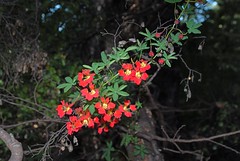
a weed on the rise
Chilean glory creeper near the Akaroa road between Little River and Cooptown.
Photo by Mollivan Jon

As it turns out, my choice of photo for the talk inadvertently provided another example of the power of the NatureWatch NZ approach to crowdsourcing biodiversity observations. Why? Because my identification was wrong. Ian Hankin of the Department of Conservation had passed the same plant and had a close look at my photo and correctly identified it as not Chilean flame creeper but Chilean glory creeper, Eccremocarpus scaber (Bignoniaceae). In my defence, I took the photograph on a bike ride and didn't get close to the plant. In Hank's praise, he'd only seen the plant while driving past.

Imagine magnifying that error correction a thousand fold. In a couple of months, you'll be able to upload photos to NatureWatch NZ, suggest an identification (or flag it as "ID Please"), and then see what everyone else thinks. On the American-based iNaturalist site on which NatureWatch NZ is based, I've had my photos of American plants identified by other users in a couple of hours, sometimes a day or two. It's a magical thing.

For the record, here's what Chilean flame creeper really looks like. This is a photo I took in Lord's Bush, near Springfield.

Tropaeolum speciosum
Chilean flame creeper in flower in Lord's Bush.
Photo by Mollivan Jon

Both species are environmental weeds on the rise (here are the Weedbusters pages on Chilean glory creeper and Chilean flame creeper). It would be great if you got to know these species and recorded them wherever you saw them.

Saturday, June 23, 2012

NatureWatch NZ is coming!

We've been hard at work here at NZBRN over the past year working on our replacement to our current web bio-recording system. We've joined the open-source iNaturalist project and have been busy optimising the system for New Zealand and adding on legacy NZBRN features you've come to depend on. It's looking really good and we are on track to launch in August. Here's a quick peak at the new features we'll be introducing.

First, a brand new and shiny system deserves a shiny new name. You won't need to be NZBRNing on your next tramp. Now you can NatureWatch.
NatureWatch NZ
Built by NZBRN | powered by iNaturalist
We decided on NatureWatch NZ after an extensive and surprisingly emotive debate and vote amongst a selection of 85 of our keenest users and supporters (thanks everyone!). Initial suggestions playing on our new iNaturalist connections, kiwiNaturalist and nzNaturalist, were shot down by people concerned they'd be obligated to do their nature watching without any clothes.

So what will the new system be able to do for you? Check out these great new features, baked right into the iNaturalist DNA by the clever iNaturalist developers.
More...
  • Photo uploads! Upload to NatureWatch NZ directly or connect to us from your Flickr or Picasa web galleries.
  • "ID please"! Flag you observations with photos as ID please and other NatureWatch users will suggest identifications.
  • Challenge and agree with IDs! Crowd-sourcing at its best, NatureWatch NZ lets everyone correct the errors they see in each others observations.
  • Comment on observations! Do you want to know how someone got that amazing photo? Or how they got so close to such an elusive animal? Start up a conversation.
  • Follow other users! If you discover another NatureWatch NZ user making interesting observations in your area, or of species you're really interested in, you can follow them to automatically see all of their new observations.
  • Join and create projects! Get together with like minded people in a project. It could be your community restoration group. It could be your school nature watch project. It could be fans of jumping spiders.
  • Life lists, and species lists per place! You can easily use NatureWatch NZ to view a list of all the species you've recorded. You can also browse places and see a list of all the species found there. If NatureWatch NZ doesn't have the place you want, you can make it by drawing a polygon on our map.
  • iPhone and Android apps! Because, seriously, who carries a computer out into the wild. If you've got a smart phone in your pocket, add your observations on the spot, whether you're online or offline.
NatureWatch NZ

You can pop on over to iNaturalist and get an idea of what NatureWatch NZ will offer. But we'll also do more than that. We're busy at the moment getting NatureWatch NZ hooked up to the about-to-be-launched New Zealand Organisms Register, so you'll be able to record an observation of any species in New Zealand, be it a silvereye or a starfish. Plus we're making it easier for you to record more details about your observations, like what species it's eating. And we're working on a list of refinements and new features that we'll continue to release over the next 12 months after NatureWatch NZ is available.

We're all very excited. This is everything we wanted when NZBRN started in 2005, and a whole lot more.

Wednesday, June 6, 2012

Helping watch the world's biodiversity

NZBRN was part of the recent workshop in Lincoln and Christchurch on GEO-BON, the biodiversity observation network (BON) of the United Nations Group on Earth Observations (GEO). GEO-BON is attempting to establish a global biodiversity observation system to better track biodiversity changes. Biodiversity remains the poor cousin of more thoroughly monitored environmental factors like carbon, nitrogen, climate, and fresh water, despite the world being on the cusp of the biggest extinction event since the loss of the dinosaurs. GEO-BON is trying to change that. Henrique Pereira of GEO-BON visited New Zealand to learn about how we do things here.
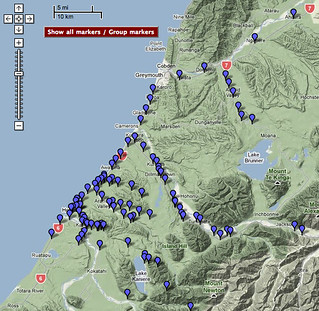
West Coast roadmap in harriers
Keen NZBRN user Mark Crompton's map of West Coast roads using his Australasian harrier observations.

Henrique started the NZ BioData workshop by introducing us to the problem. It's alarmingly difficult to get a global-scale picture of the biodiversity crisis. Even assessing land cover changes on a global scale is difficult, as the necessary information is scattered. The few high-quality, large-scale, long-term biodiversity datasets, mostly from Europe and North America and strongly biased towards vertebrates, paint a grim picture of widespread ongoing declines in most groups. We need comparable long-term data from a wider variety of groups across the whole world to properly assess the true extent of the biodiversity crisis. Henrique's suggestion is to set up some simple monitoring of birds, butterflies, and plants across a global network of repeatedly visited sites.

More...
It was clear in the workshop that New Zealand is leading the world in many aspects of biodiversity monitoring, especially with the Department of Conservation's Natural Heritage Management System (NHMS) that has begun to repeatedly visit a grid of plots across all of New Zealand's public wildlands. By collaborating with New Zealand's carbon monitoring programme (currently called LUCAS), DOC is monitoring detailed biodiversity information from public wildlands in an 8 km square grid across the whole country. We will be well placed from this to record how native and exotic biodiversity in these plots changes over time as environmental change accelerates (climate, nitrogen cycle, phosphorous cycle, biological invasions, etc.).

NZBRN was well represented at the workshop and I gave a talk about what NZBRN has achieved since we began in 2005. I also gave an overview of where we're heading with our new iNaturalist-based system, which will be launched later this year. You can see a copy of my talk here. (We were pleased to learn that Henrique was well-familar with iNaturalist and they were already in discussions with GEO-BON.)
NZBRN talk at BioData Workshop
Here's a copy of our talk on NZBRN at the BioData workshop (3.5 MB PDF).

Henrique concluded that it is a myth that the data is out there to be collated. There's a big role for "citizen science" in collecting data, and most of the long-term biodiversity datasets we have globally are collected wholly or in part by volunteers (just like New Zealand's excellent bird atlas project of the Ornithological Society of New Zealand and the garden bird survey). It's up to us all to collectively open our eyes to the nature around us and watch how our activities are changing the world.

Thursday, August 25, 2011

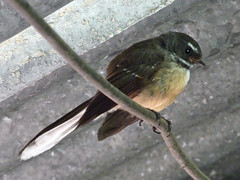
Where are the fantails that survived the big snow?

Our unseasonably warm winter was interrupted by two ferocious southerly storms that dumped snow across much of New Zealand. My home town of Christchurch was buried for days while raked by strong, chilling winds fresh from Antarctica. While we all had the luxury to bundle up inside our houses around our fires or heat pumps, wild nature was left outside to struggle through the storm. As in past late winter snow storms, it looks like fantails have been hit particularly hard (except for three desperate, clever birds that sheltered inside someone's house).

I am an avid bird counter (my wife would say obsessive) and I've yet to see a single fantail since the second big snow, which ended over a week ago. On my weekly runs between Wigram and the Cashmere hills, I almost always see fantails. I've done two runs since the snow, and no fantails. On my bike into work at Lincoln, I usually see fantails, almost always when I go the long way through Tai Tapu. So far, three rides, including through Tai Tapu, and no fantails. My wife saw one fantail at Victoria Park yesterday, just one, after we've spent several hours in combination there since the snow.

How about you? Have you seen fantails? Where? Now is the time to use NZBRN and record where you are seeing, and equally importantly, not seeing fantails. When using NZBRN, you can tick the "Sought but not found" box to mark places and times where you looked for fantails unsuccessfully.

This is an important opportunity to learn where in our landscapes most fantails survive these storms. Fantails are prolific breeders and eventually bounced back after the big 1992 August snow storm. It is quite plausible that some places are where most of the survivors are, and these places play a disproportionately large role in the population's recovery. Perhaps it's sheltered dense lowland forests on low northern slopes facing away from the storm (not that Christchurch has any of them left). In Christchurch, perhaps it's Bottlelake Plantation, a large lowland pine plantation that presumably is partially sheltered from the worst of the winds and snow by Banks Peninsula. Perhaps it's sheltered well-wooded gardens without cats.

Only lots of your observations can tell us this.

Go the All Blacks?
In the South Island, we have both pied and black phase fantails. The black birds are found only rarely in the North Island and are associated with the colder climes here in the South Island. If you decide to record survivors of the 2011 Big Snow, it would also be useful if you recorded in the NZBRN comments whether each bird you see is pied or black. Perhaps the black birds, by soaking up more sunshine, were a bit better able to cope with the recent bleak conditions. The fantail population may become more black just in time for the Rugby World Cup!

Wednesday, June 29, 2011

It's bird spotting time!

It's time again for the annual New Zealand garden bird survey. You've got until this Sunday (3 July) to add to the annual national effort to document birds in our gardens. All you need to do is spend one hour noting the maximum number of each bird species that you see at any one time.

Eric Spurr, the project coordinator, told us the following about last year's survey.

Silvereye returned to the top of the table of species counted in greatest numbers, with house sparrow second, starling third, and blackbird fourth. A grand total of 187,858 birds were counted in 4193 gardens (an average of nearly 45 birds per garden). This included 55,543 silvereyes, 52,779 house sparrows, 11,837starlings, and 11,156 blackbirds. These species have been the top four in all four years of the survey. As in previous years, the only other native species apart from silvereye to make the top 10 were tui and fantail.


These annual surveys are a useful way to document which birds are using our gardens and how our bird communities are changing.

Instructions and a summary of past years' findings can be found at the New Zealand Garden Bird Survey. The results of the past bird surveys are all available through NZBRN (Eric is still following up on some unusual observations in the 2010 data).

If you miss this survey or get enthused about documenting the birds using your garden at other times of the year, you can store and share your garden observations on NZBRN at any time (and not just of birds but also other animals, plants, and fungi). If birds and only birds are your thing, another good web option is eBird.

NZBRN distribution maps come to nzbutterfly info

Those of you who like butterflies have likely already discovered Robert Arter-Williamson's excellent compendium of information at www.nzbutterfly.info. There's lots of information about all of New Zealand's butterfly species. You can now also view live NZBRN distribution maps for each species from the webpages of www.nzbutterfly.info.

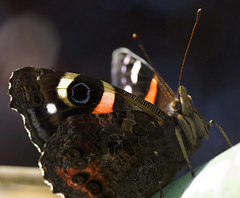
For example, if you go to the red admiral page, you'll see an NZBRN logo on the right-hand column. Clicking it will pop up a map showing all red admiral observations in NZBRN. Handy!

If you want to add maps like this to your own website, we have a blog post of instructions all about it.

The other thing you'll note if you explore these maps is that we need a lot more observations to properly map out the distributions of these butterflies. Get ready to spot butterflies in the spring, and if you have any old butterfly observations, please consider sharing them with the world using NZBRN.